The Market's Fever Dream: Why Strong Earnings Don't Matter Anymore
On Tuesday morning, the numbers looked good. JPMorgan Chase, Goldman Sachs, Wells Fargo, Citigroup—the titans of American finance—all posted quarterly earnings that beat expectations. Johnson & Johnson, a bellwether for the healthcare sector, did the same. In a rational market, this cascade of positive fundamental data should have set a floor under stock prices, if not sparked a rally.
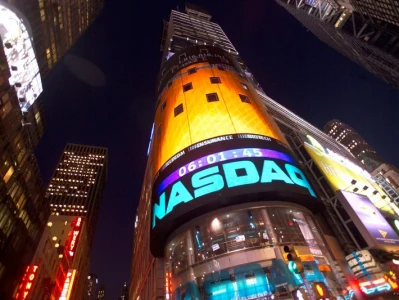
Instead, the Nasdaq opened down 1.4% and closed off by nearly 1%. The sell-off was concentrated and telling: AI darlings like Nvidia fell almost 4%, with Oracle and Tesla not far behind. The S&P 500 and the Dow followed suit, albeit with smaller losses, a turn of events summarized by headlines like S&P 500 falls again after one-day respite as China trade tensions persist: Live updates.
The disconnect is glaring. The engine of corporate profitability is humming along nicely, yet the market vehicle is swerving violently based on the whims of geopolitical headlines. The narrative that strong earnings create a strong market is, for the moment, a fiction. The data from this week doesn't just suggest this; it screams it. The question is no longer about the health of corporate America, but about the stability of the entire system when its primary inputs are no longer balance sheets, but diplomatic cables and angry social media posts.
A Three-Day Whiplash
To understand Tuesday’s decline, you have to look at the preceding 72 hours. It was a textbook case of a market driven by sentiment, not analysis. On Friday, President Trump’s threat of a 100% tariff on Chinese goods sent the Dow spiraling down over 800 points. The S&P 500 recorded its largest single-day loss since mid-April. Fear was the only asset trading at a premium.
Then came Sunday. A simple post on Truth Social—"Don’t worry about China, it will all be fine"—was all it took to reverse the panic. On Monday, the S&P 500 and the Dow both jumped more than 1%. It was the S&P’s best day in nearly five months. The entire basis for this rally was a single, vague assurance from the President.
This brings us to Tuesday. The market’s fragile confidence was shattered not by a poor economic indicator or a Federal Reserve announcement, but by a targeted sanction from Beijing against five U.S. subsidiaries of a South Korean company, Hanwha Ocean. The move itself was strategically minor, but its signal was deafening. It was a direct retaliation, a sign that the trade war’s temperature was rising again. And just like that, Monday’s euphoria evaporated.
Let's be precise about the volatility here. We're witnessing multi-trillion-dollar swings in valuation based on what amounts to a war of words. The market is behaving like a ship with a powerful, well-maintained engine (corporate earnings) but a rudder being jerked back and forth by two feuding captains. The ship is moving powerfully, but it has no coherent direction. It’s motion without progress. And I've looked at market data for years; this kind of high-amplitude, headline-driven oscillation is a classic symptom of a system that has lost its fundamental anchor.
The Fear Gauge Is Redlining
The most objective measure of this anxiety is the Cboe Volatility Index (the VIX, for short). On Tuesday, it spiked above 22, a four-month high. Wall Street calls it the "fear gauge," which is a bit simplistic. More accurately, it measures the market's expectation of 30-day volatility. A high VIX doesn't just mean investors are scared; it means they are pricing in a future of violent, unpredictable swings. They are buying protection because they have no idea what’s coming next.
This is the core of the problem. As Rob Haworth at U.S. Bank Wealth Management noted, the market is struggling with the lack of a clear resolution on trade. This uncertainty is acting like a gravitational force, pulling everything down and overriding the lift from strong earnings. Treasury Secretary Scott Bessent’s comment that China is trying to "pull everybody else down with them" is a political statement, but it reflects the market’s functional reality: geopolitical risk is now the dominant pricing factor.
The data is telling a story of profound cognitive dissonance. How can a market be both fundamentally strong, evidenced by broad-based earnings beats, and structurally terrified, evidenced by a spiking VIX? The logical conclusion is that one of these signals is being ignored. Right now, the fundamentals are the signal, and geopolitics is the noise. But the market has its volume turned up on the noise.
At what point does this become unsustainable? Can a market indefinitely ignore the cash-generating power of its underlying assets in favor of parsing the subtext of diplomatic spats? History suggests that eventually, fundamentals reassert themselves. But the timeline for that correction is entirely unknown, and the damage done by trading on impulse in the interim can be immense.
Fundamentals Are Now a Footnote
My analysis leads to a stark and uncomfortable conclusion. We are no longer in a market where you can reliably model outcomes based on price-to-earnings ratios, discounted cash flow, or forward guidance. The primary variable is political whim. The most valuable analyst on Wall Street right now isn't the one with the most complex financial model, but the one who can best predict a politician's next tweet.
This is not a stable environment. The recent sell-off, as Doug Ramsey of Leuthold Group suggested, might simply be pushing out the bull market's eventual peak. But it’s also introducing a level of systemic fragility that should concern any long-term investor. When the collective mood can swing from panic to euphoria and back to anxiety in three days—all while the actual performance of the economy’s largest companies remains robust—it means the market's price discovery mechanism is broken. It's trading on rumor and rhetoric, and fundamentals have been relegated to a footnote.