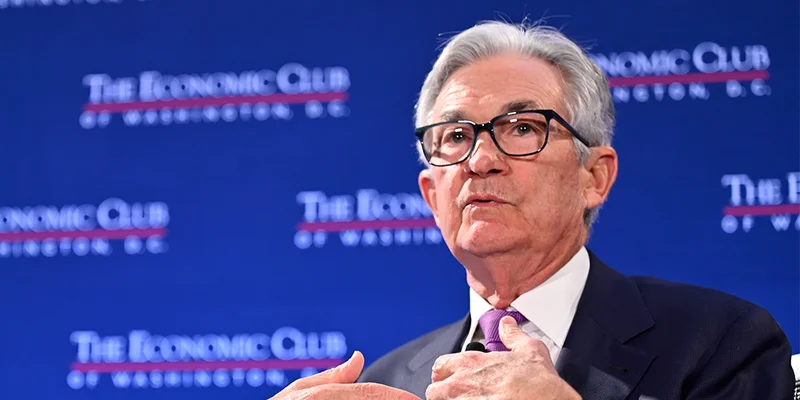
Here we go again. The familiar ritual played out this week, a piece of theater for the markets that feels increasingly disconnected from the world you and I actually live in. The Federal Open Market Committee—the high priests of our monetary system—gathered in their marble halls, consulted their arcane charts, and decided to nudge a lever. They cut the policy rate by 25 basis points.
The financial news exploded, of course. Traders stared intently at their screens, watching the US Dollar Index twitch. The headlines breathlessly detailed the internal squabbles: some Fed officials wanted a bigger cut, one even dissented, while others thought it was best to do nothing at all. They debated slowing job gains and the specter of inflation, pointing fingers at tariffs like they were some novel economic force.
It’s all so… 20th century.
Honestly, when I read the initial reports, I felt a profound sense of exhaustion. Are we really still having the same conversation? It’s like watching brilliant mechanics meticulously tuning a horse-drawn carriage while a silent, electric supercar glides past them on the highway. They are masters of a machine that is rapidly becoming a relic. But then, buried deep within the official minutes, I saw it. A single, quiet sentence that told me everything I needed to know. A sentence that reveals the ghost in their machine and points toward the real economic revolution that’s already underway.
The Line Item They All Missed
Tucked away, almost as an afterthought, the minutes noted that the "adoption of artificial intelligence and automation was cited as a potential factor that could reduce future labor demand."
When I first read that, I honestly just sat back in my chair and laughed. A potential factor? That’s like calling the invention of the steam engine a “potential factor” in the future of manual labor. This isn't some distant, theoretical risk to be modeled in a footnote; it is the single most powerful economic force of our lifetime, and it's happening right now. The debate over whether to cut rates by 25 or 50 basis points is a complete sideshow. The real story isn’t about the cost of borrowing money; it’s about a world where the very nature of human labor is being fundamentally redefined.
The Fed is wrestling with old problems using old tools. They see slowing job gains and try to stimulate the economy with a rate cut. But what if the reason for slowing job growth isn't a cyclical downturn, but a permanent, structural shift? What if the jobs they’re trying to save are simply not coming back, replaced by algorithms and automated systems that are exponentially more efficient? The Fed is essentially trying to adjust the sails on a massive ship to catch a changing wind, all while ignoring the silent, deep-ocean current of technological progress that has already grabbed the hull and is pulling it in an entirely new direction.
This isn't about scaring people. This is about being realistic about the sheer scale of the change we are living through. The FOMC is worried about tariff-induced price hikes on consumer goods, a temporary blip. Meanwhile, AI is on the verge of creating a deflationary wave of abundance so massive it will make their 2% inflation target look completely arbitrary. We're talking about a paradigm shift—in simpler terms, the rulebook for how our economy works is being completely rewritten. Are we truly prepared for that?
Rewriting the Economic Source Code
For centuries, our economic models have been built on a few core assumptions: human labor is a primary input, productivity grows at a slow and steady pace, and capital is scarce. AI and automation are taking a sledgehammer to every single one of those pillars.
Think about it. We are entering an era where cognitive work, not just physical work, can be automated and scaled infinitely for near-zero marginal cost. This is the kind of breakthrough that reminds me why I got into this field in the first place—the sheer speed of this is just staggering, it means the gap between a wild science-fiction idea and a deployed commercial product is shrinking from decades to months, and our institutions simply can’t keep up. The Fed's models, built for a world of factories and filing cabinets, are trying to measure an economy that increasingly lives on servers and in neural networks.
This isn’t the first time humanity has faced such a moment. The printing press didn't just make it cheaper to produce books; it decentralized knowledge, fueled the Reformation, and laid the groundwork for the Enlightenment. The Industrial Revolution didn't just create factories; it reordered society, built new cities, and created new social classes. AI is a force of that magnitude. It isn't just a new tool; it's a new operating system for human ingenuity.
And that brings us to the most important question, the one that I wish was being debated in those DC meeting rooms. As we build this new world, what are our values? If AI can generate unprecedented wealth and solve problems we once thought intractable, how do we ensure that prosperity is shared? How do we build a society where technology liberates human potential instead of just displacing human labor? This isn't just an economic challenge; it's a moral and philosophical one. We have a once-in-a-generation opportunity to design a future that is more equitable, creative, and abundant for everyone. But we can't do that if we’re still fixated on the old dials and levers.
The market may have reacted to the Fed's announcement by nudging the dollar up a fraction of a percent. But that’s just noise. The real signal is the quiet hum of servers in data centers around the world, learning, iterating, and building the foundations of a new economy right under our feet. The question is, when will our leaders stop looking at their old maps and start paying attention to the new landscape being created all around them?
The Future Isn't in the Minutes; It's in the Code
Let's be perfectly clear. The arguments happening inside the Federal Reserve are an echo from a fading era. They are debating the finer points of a system whose fundamental assumptions are dissolving day by day. The real economic policy for the 21st century isn't being set by interest rates; it's being written in Python and deployed on the cloud. While we obsess over fractional percentage points, a new world of unimaginable productivity and abundance is being born. It’s time we stopped staring at the rearview mirror and grabbed the wheel. The future is arriving, and it won't wait for the FOMC to approve it.