Title: Bitcoin's Wild Ride: From Red October to AI-Fueled Hope?
Bitcoin's been doing the crypto equivalent of a rollercoaster lately. After a rough October, where it dipped 1.4% over 24 hours and traded around $107,000, (CoinGecko data), everyone's wondering if the bull run is over, or if this is just a pit stop before the next surge. The sell-off triggered over $1.16 billion in long liquidations on November 3rd. A significant leverage unwind, to say the least.
Decoding the October Dip
October's downturn happened against a backdrop of macroeconomic jitters. Federal Reserve Chair Powell hinted at the end of quantitative tightening and rate cuts, but then walked back some of that enthusiasm. This uncertainty tends to spook risk assets, and Bitcoin felt the chill. Velo data shows Bitcoin's U.S.-session returns cooled from 0.94% on October 29 to -4.56% over the past week. That’s a pretty steep drop. Geopolitical tensions easing? Sure, the Trump-Xi agreement provided a temporary truce, but that doesn't erase the underlying economic anxieties.
Then you’ve got the ETF flows. BlackRock's IBIT shed $291 million in a day. Ouch. It’s never a good sign when even the big players are pulling back.
But here's where it gets interesting. Rachel Lin, CEO of SynFutures, thinks this "Red October" could actually set up the next major leg of Bitcoin's bull cycle. Her argument? Corrections are often the midpoint of a broader cycle, not the end. Historical data backs this up to some extent: Bitcoin's mean return for the third quarter remains positive at 6.05%. And November has historically been a good month for Bitcoin, posting a mean return of 42% over the past 12 years. I’ve looked at enough of these trends to know past performance isn’t a guarantee, but it’s certainly something to consider.
Lin expects "a period of stabilization and cautious optimism" in November. Bitcoin might trade sideways early in the month as markets digest Fed commentary. But a decisive shift in tone could trigger a recovery. If Bitcoin follows its typical post-halving pattern, Lin believes a move toward $120,000 to $150,000 by the end of 2025 remains within reach. She cites strong underlying fundamentals from ETF flows to institutional custody solutions.
The Strategy Play and the AI Wildcard
Enter Strategy, led by Michael Saylor. They're planning an initial public offering of 3.5 million shares of their euro-denominated perpetual preferred stock (STRE) to fund future bitcoin acquisitions. They plan to use the net proceeds to support general corporate purposes, including bitcoin acquisitions and working capital. The STRE Stock carries a 10% annual cumulative dividend on the €100 stated amount, payable quarterly in cash starting Dec. 31, 2025. Unpaid dividends compound quarterly, initially at 11%, rising by 100 basis points per period to a maximum of 18%.

Saylor pioneered the use of company equity and debt offerings to finance cryptocurrency acquisitions. They bought 397 BTC for roughly $45.6 million at an average price of $114,771 per bitcoin, bringing its total holdings to 641,205 BTC. While the company's bitcoin purchases slowed in the third quarter, analysts at Mizuho, TD Cowen and Benchmark issued positive 2026 outlooks, saying its bitcoin acquisition model remains largely sustainable.
Strategy's stock, traded under ticker MSTR, closed down 1.8% at $264.67 on Monday. It has fallen 24.73% over the past month and dropped 11.78% year-to-date. Bitcoin is down 2.57% to trade at $106,865.
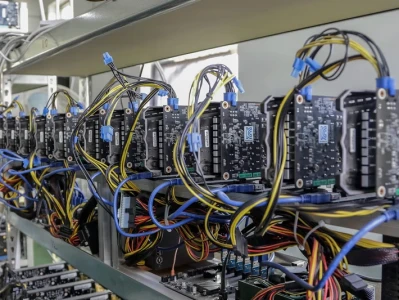
But the real kicker? The AI play. IREN, a bitcoin miner-turned-AI diversifier, announced a multi-year GPU cloud services contract with Microsoft. A five-year, $9.7 billion agreement. They also entered into a $5.8 billion deal with Dell Technologies to acquire GPUs and related equipment. IREN shares surge nearly 30% as bitcoin miner inks $9.7 billion AI cloud deal with Microsoft IREN's stock gained nearly 30% at one point in pre-market trading on Monday, before correcting. It is currently changing hands for $74.51, per TradingView — having already gained about 490% year-to-date.
Analysts at Bernstein said IREN's AI cloud buildout could deliver $500 million in annual revenue by early 2026. "Together with IREN, Microsoft is delivering cutting-edge AI infrastructure for our customers," Jonathan Tinter, President, Business Development and Ventures at Microsoft said. "IREN's expertise in building and operating a fully integrated AI cloud — from data centers to GPU stack — combined with their secured power capacity makes them a strategic partner." This is where I think the future is going. Bitcoin miners aren't just about hashing algorithms anymore; they're becoming power brokers in the AI revolution.
US Bitcoin ETFs had $946 million in outflows last week, with iShares Bitcoin Trust losing $400 million. Solana ETFs attracted $421 million in new investments, driven by recently launched U.S.-based funds. Total digital asset fund outflows reached $360 million as investors reacted to U.S. central bank Chair Jerome Powell's cautious stance on December rate cuts.
At the time of writing, Bitcoin was trading for $107,463 after having dropped 2.5% in the past day. And Ethereum was trading for $3,657.77, about 5.1% lower than it was this time Sunday, according to crypto price aggregator CoinGecko.
A Glimmer of Hope, But Don't Bet the Farm
So, what's the real takeaway? Bitcoin's October stumble wasn't pretty, and the ETF outflows are concerning. But the long-term picture is far from bleak. The AI angle, in particular, offers a compelling narrative. Bitcoin miners adapting their infrastructure for AI workloads could be a game-changer, providing a new source of revenue and stability. Ultimately, this is a volatile market. Invest with caution, and don't believe the hype.