The Relentless Rhythm of Progress: Why This Week's Launch Isn't Just About Satellites
Another rocket is about to tear a hole in the Florida night sky. On Thursday, a SpaceX Falcon 9 will roar to life at Cape Canaveral, carrying 24 of Amazon’s Project Kuiper satellites into orbit. On paper, it’s Mission KF-03, a routine delivery to low-Earth orbit. Another step in Amazon’s grand plan to blanket the globe in high-speed internet.
But if you think that’s the real story, you’re looking through the wrong end of the telescope.
The payload is almost irrelevant. The true breakthrough, the paradigm shift we’re all living through, isn’t about these specific 24 satellites. It’s about the fact that this will be the 85th orbital launch from the Space Coast this year. It’s October 9th. Last year, a record-breaking year, we didn’t hit launch number 85 until November 30th.
This isn't just an increase; it's an acceleration. A fundamental change in the rhythm of human ambition. We're witnessing the industrialization of space, and it’s happening at a speed that is simply breathtaking. When I first mapped out the 2025 launch schedule against 2024's, I honestly had to double-check the numbers. It felt like a typo. It wasn't. This is the kind of progress that reminds me why I got into this field in the first place. We're not just visiting space anymore. We're building a permanent highway to the stars, and the traffic is getting heavier every single week.
The New Space Race Is Against the Clock
For decades, space launches were monumental, singular events. Each one was a national spectacle, the culmination of years of work and billions of dollars. We held our breath for every countdown. Now? A launch from Florida is happening, on average, every three to four days. The 84th launch of the year was just two days ago, a Starlink mission. The cadence is becoming so routine, so utterly predictable, that it’s almost starting to feel mundane.
And that’s the most revolutionary part.
This relentless pace is the real engine driving the future. It’s what allows a project like Amazon's Kuiper to even exist. The project aims to create a constellation of over 3,200 satellites—in simpler terms, a massive, interconnected web in the sky designed to provide internet to every corner of the globe. A decade ago, the logistics of launching that many satellites would have been pure science fiction. Today, it’s just a matter of booking the rides.
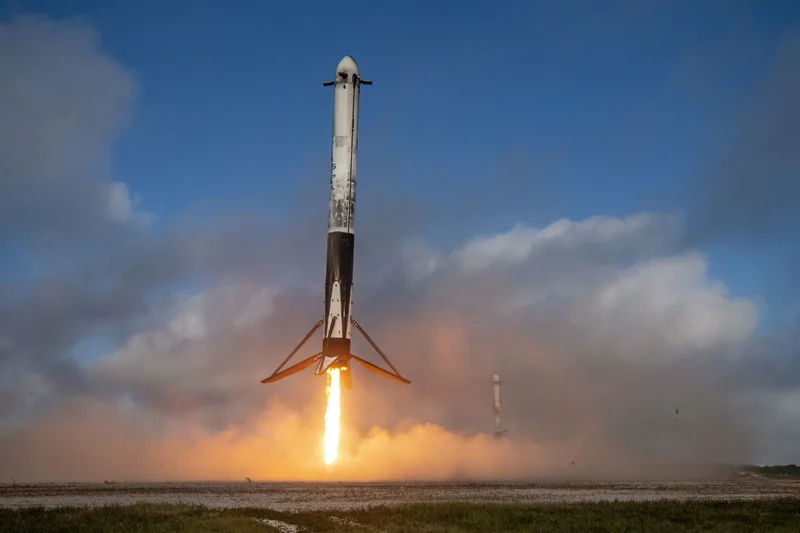
Think of it like the transcontinental railroad in the 19th century. The individual trains and their cargo were important, sure, but the real story was the track being laid, mile by agonizing mile, across a continent. That track unlocked a new economic reality. It connected markets, moved people, and fundamentally rewired the nation. We are doing the same thing today, but our continent is the void above our heads, and our tracks are the launch trajectories being blazed by Falcon 9s, Atlas Vs, and soon, Vulcans and New Glenns.
The speed of this is just staggering—it means the gap between a brilliant idea scribbled on a whiteboard and a functioning global infrastructure in orbit is closing faster than we can even fully comprehend. This isn't a race between SpaceX and ULA for a few lucrative national security contracts, though those are certainly part of the picture. It’s a race against time itself, a collective human effort to build the foundational layer for the next economy. What happens when the cost and complexity of reaching orbit drop so low that a university, a small startup, or even a group of brilliant individuals can deploy their own technology?
From Grand Visions to Orbital Reality
This new reality is forcing a complete rewiring of our thinking. We see it in the contracts being handed out. SpaceX just secured five national security missions for 2026, and ULA has two more on its manifest. These aren’t one-off science experiments; they are critical pieces of national infrastructure being deployed with the regularity of a municipal bus schedule. The fact that Blue Origin’s New Glenn isn’t yet certified for these missions isn't a failure, but a sign of how high the barrier to entry has become. You don’t just need a rocket; you need a rocket that can fly, and fly often.
This relentless launch cadence is what turns a vision like Project Kuiper from a multi-decade dream into a five-year business plan. Imagine standing on the Florida coast, the humid night air suddenly vibrating in your chest, a man-made star climbing against the black velvet of the sky on its northeasterly path. You aren't just watching a rocket. You're watching another 24 nodes of a future global nervous system being slotted into place. With this launch, Kuiper's constellation grows to 153 satellites, a tiny fraction of its goal, but each launch is another proof point of the system's viability.
Of course, with this incredible power comes profound responsibility. As we fill the sky with these constellations, what are our obligations to manage orbital debris? How do we ensure that low-Earth orbit remains a resource accessible to all nations, not just the ones who can afford a fleet of rockets? These aren't trivial questions, and we need to be designing the answers with the same ingenuity we're using to design the hardware. The new frontier requires new rules of the road.
But the sheer possibility is what should capture our imagination. We are building a platform. The internet constellations of today are just the first application layer. What comes next? What industries will be born when persistent, high-resolution monitoring of our planet is cheap and ubiquitous? What scientific breakthroughs will occur when we can deploy and service orbital telescopes with the ease we now service cell towers?
A New Foundation for Tomorrow
So, as you see the headlines about another Amazon satellite launch, I urge you to look past the payload. Don’t focus on the 24 satellites. Focus on the number 85. Focus on the 52-day lead over last year’s record. That number represents the laying of a new foundation, the pouring of concrete for a highway that will take us to places we are only just beginning to imagine. The satellites are the first cars on that road, but the road itself is the masterpiece. And it’s being built right now, one launch at a time.