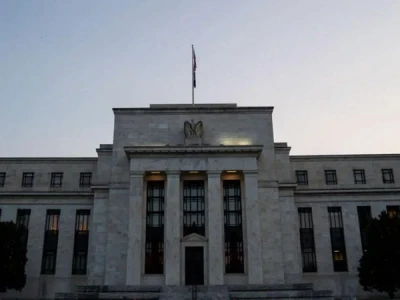
The Federal Reserve cut its benchmark interest rate by a quarter of a percentage point on Wednesday. On the surface, this was the expected move—a continuation of the easing cycle that began in September, aimed at shoring up a visibly weakening labor market. The new federal funds rate now sits in a range between 3.75% and 4%. Markets, which live and die by such decisions, should have been placated.
They weren’t.
The Dow and S&P 500 both slipped into the red shortly after Fed Chair Jerome Powell took the podium. The actual rate cut, it turns out, was merely the preamble. The real story, the one that erased modest gains and sent a ripple of anxiety through trading desks, was Powell’s deliberate and uncharacteristically blunt injection of uncertainty into the outlook for December. He effectively took the market’s carefully constructed forecast for another rate cut and threw it into question.
In his press conference, Powell stated that a further reduction at the next meeting "isn't a foregone conclusion. In fact, far from it." This comment was the basis for reports that the Fed cuts rates again, but Powell raises doubts about easing at next meeting. This isn't the typical, carefully hedged Fedspeak we’re accustomed to. This was a clear, calculated signal. The Fed just gave the market the accommodation it wanted, but the price was the removal of certainty. And if there’s one thing the market despises more than bad news, it’s a data void.
Navigating in a Statistical Fog
To understand Powell’s hesitation, you have to look at the dashboard in front of him. The problem is, most of the gauges are dark. The ongoing U.S. government shutdown has triggered a near-total blackout of official economic data. The Bureau of Labor Statistics isn’t releasing its jobs report. Key inflation and spending metrics are delayed. The Fed, an institution that prides itself on being data-dependent, is flying blind.
Powell’s own analogy was telling. "What do you do when you are driving in the fog?" he asked. "You slow down." This is precisely the posture the Fed is now adopting. The 25 basis point cut was a nod to the data we do have—namely, indicators of a cooling labor market, like the ADP report showing a private-sector payroll decline of 32,000 last month. But promising another cut without the government's official unemployment and inflation data would be irresponsible. It would be policy based on assumption, not analysis.

This predicament is amplified by the Fed's dual mandate. Inflation, while down from its 2022 peak (a staggering 9.1%), is still running at 3% as of September. That’s a full percentage point above the Fed’s 2% target. So, the committee is in a bind: it sees signs of employment risk that demand easing, yet inflation remains too high to declare victory. Easing too aggressively could reignite price pressures, while failing to act could tip a slowing economy into a recession. It's a classic stagflationary tightrope walk, and they're doing it without a net of reliable data.
The internal disagreement within the Federal Open Market Committee underscores this tension. The vote was 10-2, a significant split. Fed Governor Stephen Miran, a more recent appointee, dissented in favor of a more aggressive 50 basis point cut. Meanwhile, Kansas City Fed President Jeffry Schmid wanted no change at all. I've looked at hundreds of these voting records, and a three-way split in opinion (cut more, cut this much, don't cut) is a textbook indicator of profound uncertainty within the committee itself. They aren’t reading from the same sheet of music because the orchestra pit is dark.
The Market's Misread
The negative market reaction was, in my analysis, a fundamental misinterpretation of the Fed's position. Investors had priced in not just this cut, but a clear path toward another in December. They were trading on a narrative of a predictably dovish Fed. Powell’s job at the press conference was to disrupt that narrative. He wasn't signaling a hawkish turn; he was signaling a pause dictated by prudence.
The market heard "no more cuts" when what Powell was actually saying was "no more guaranteed cuts until we can see the road again." The Fed has now delivered 50 basis points of cuts in the last two meetings—or to be more exact, two consecutive 25 basis point reductions. From a policymaker's perspective, it’s perfectly logical to pause and assess the impact of that stimulus, especially when your primary information sources are offline.
This is where the political theater surrounding the Fed becomes a factor, though one that's difficult to quantify. The Trump administration has been openly calling for much deeper cuts, adding a layer of political pressure that complicates the Fed's communication. The recent drama involving board members, including an attempt to oust Governor Lisa Cook, only adds to the noise. Powell’s direct, unambiguous statement about December feels like an attempt to reassert the Fed's independence and its commitment to data, even when that data is absent.
The core issue is that the market craves a simple, linear story. The economic reality, however, is anything but. We have a slowing labor market, persistent inflation, a government shutdown creating a data vacuum, and internal disagreement at the world’s most powerful central bank. In that context, what is the rational path forward? Is it to blindly follow a pre-determined path of rate cuts, or is it to slow down, wait for the fog to lift, and make a decision with the best available information?
A Calculated Response to Missing Data
The market’s brief sell-off wasn’t a reaction to a policy mistake. It was a tantrum in response to having its forward guidance taken away. Jerome Powell didn't waver or show indecision; he demonstrated exactly the data-dependency he has long preached. When the data disappears, the only logical course of action is to pause. This isn't a pivot to a hawkish stance. It's a disciplined, methodological response to an unprecedented lack of visibility. The Fed is telling us that it refuses to gamble, and for a central bank, that's the most reassuring signal of all.