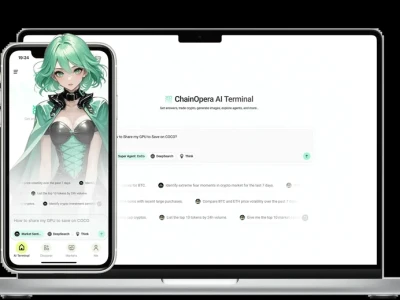
It’s not every day you see a rocket ship take off from a launchpad that seemed to appear overnight. But that’s exactly what the story of ChainOpera AI ($COAI) feels like. One moment, the AI and Web3 space was humming along, and the next, bam—a project ignites, blasting past a $4 billion valuation and landing on every major exchange from Binance to Bybit. When I first saw the numbers, I had to double-check them. A single project dominating the AI Agent track, its valuation dwarfing its peers.
This wasn’t just a spark; it was a supernova. And like any brilliant explosion in the cosmos, it forces us to ask two fundamental questions: What forces created this incredible burst of energy? And more importantly, what does the light it casts tell us about the universe it inhabits? Because the story of ChainOpera AI isn't just about one token. It’s a powerful, almost poetic, reflection of the very soul of innovation right now—a thrilling, and slightly terrifying, dance between pure momentum and the search for lasting gravity.
The Anatomy of a Perfect Storm
You can’t dismiss ChainOpera’s ascent as mere luck. This was a masterclass in timing, a textbook execution of riding multiple waves at once. The project emerged just as the market’s appetite for AI and Web3 integration was reaching a fever pitch, saving them a fortune in marketing and letting them pour resources directly into their tech. It was this perfect storm of market readiness, ecosystem heat from BNB, and a massive surge in speculative trading all hitting at the exact same moment—it’s the kind of alignment you can’t engineer but that defines these explosive, lightning-in-a-bottle moments in tech.
Think of it like a surfer catching a once-in-a-lifetime wave. ChainOpera didn't create the ocean, but they saw the swell forming from a mile away. They paddled into position by building on the BNB Smart Chain right as it was becoming the most active network on the planet. They timed their launch to coincide with a massive frenzy in perpetuals trading, ensuring deep liquidity from day one. They even launched alongside another hyped project, the stablecoin $XPL, creating a traffic resonance effect that pulled in a tidal wave of attention.
For a moment, its daily trading volume was second only to giants like Bitcoin and Ethereum, a surge that prompted headlines like ChainOpera AI Volume Boom – Investors Can’t Ignore This!. This wasn't just a project launch; it was a beautifully orchestrated market event. It demonstrated a profound understanding of the crypto ecosystem's pulse, proving that in Web3, timing isn't just a factor—it can be the primary ingredient for combustion. But as any physicist will tell you, what goes up with incredible velocity must eventually reckon with the force of gravity.
The Ghost in the Machine
Just as the celebration was hitting its peak, a different set of data points began to surface, painting a more complicated picture. The surge, it turns out, was kicked off by a massive short squeeze, where traders betting against the token were forced to buy back in, artificially pumping the price. Technical charts began showing the tell-tale signs of a cooldown; Bollinger Bands tightening, momentum indicators fading. These are the quiet whispers that often precede a storm’s end.

But the truly arresting number, the one that stopped me in my tracks, was this: the top 100 wallets control over 94% of the entire COAI supply.
When I first saw that 94% figure, I honestly just had to sit back. This is the kind of breakthrough that reminds me why I got into this field in the first place, but that number... that's a different story. Let me put that in perspective for you. This uses a concept called token distribution—in simpler terms, it means the fate of this entire multi-billion dollar project rests in the hands of a group of people who could all fit in a small lecture hall. It’s a chilling reminder that even in a world built on the promise of decentralization, power can still pool in very small places.
And this is where we face our moment of ethical consideration. What is the responsibility of those 100 wallets? What is the duty of a project that allows for such concentration? This isn't a failure of technology; it's a failure of principle. It raises the question that we, as a community, must confront: are we building open ecosystems or just digital fiefdoms with new gatekeepers?
This whole dynamic reminds me of the early dot-com bubble. We saw an explosion of incredible ideas and sky-high valuations built on pure potential, and many of them collapsed under their own weight because they lacked a sustainable foundation. But that collapse wasn't the end of the story. It was a necessary, painful cleansing that paved the way for the Amazons and Googles of the world—companies that learned from the failures and built something real, something with gravity. Could the volatility of projects like ChainOpera be serving the same purpose for Web3?
The Real Signal in the Noise
So, what do we make of this paradox? Is ChainOpera AI a blueprint for success or a cautionary tale? I believe it’s both. Its explosive launch is an undeniable signal of the immense energy, capital, and excitement ready to pour into projects that can capture the imagination. It’s proof that the AI and Web3 narrative is one of the most powerful forces in technology today.
But its shaky foundation is an equally important signal. It’s the market screaming for something more. The unease around its centralized ownership and momentum-driven price action reveals a growing hunger for substance over speculation, for sustainable models over fleeting hype. The volatility we see isn't a bug; it's a feature of an immature ecosystem learning, in real-time, what it takes to build things that last. The future isn't about avoiding these wild rides. It's about using them to learn how to build better ships—ones with both powerful engines and a strong gravitational anchor. This is how we evolve.